


Minister Josephine Teo opening the Singapore Data Festival 2026
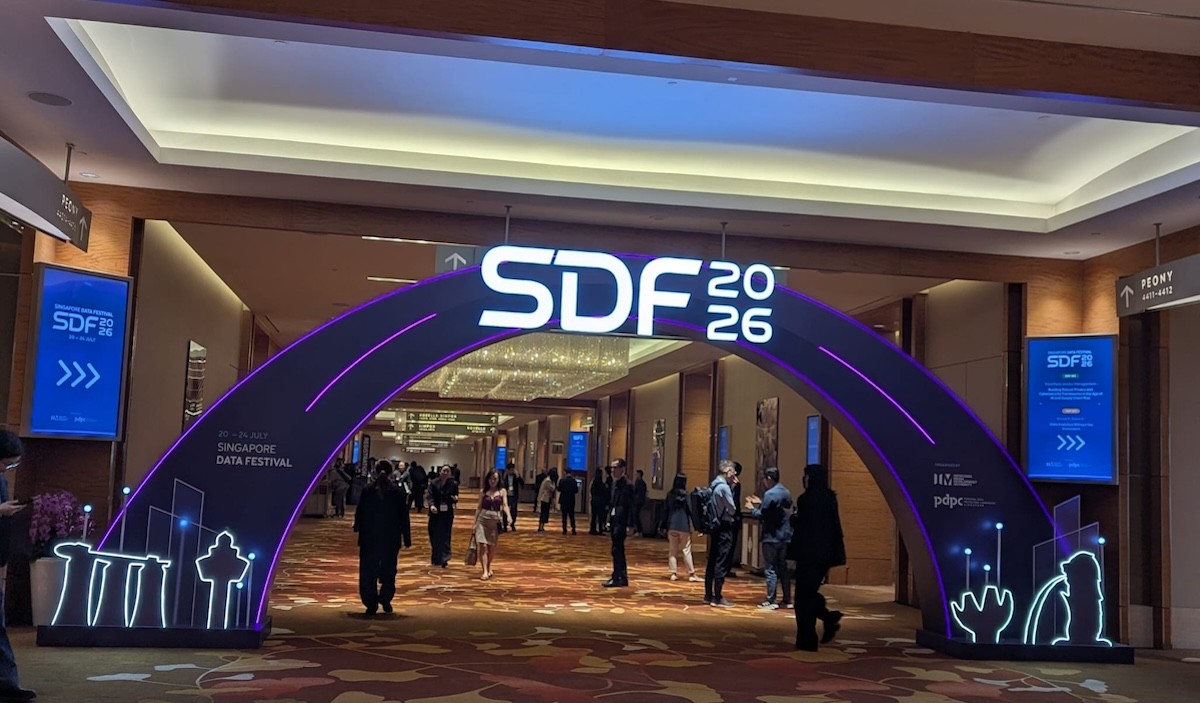
Over 2,000 data and AI leaders gathered at the Sands Expo & Convention Centre for the inaugural Singapore Data Festival (SDF), held from 20 to 24 July 2026. Opening the event, Minister for Digital Development and Information, Mrs Josephine Teo, remarked, "At its heart, data governance is about trust. Customers share data only if they trust the organisation to safeguard it properly and use it responsibly."
The PDPC announced new and revised regulatory frameworks covering Gen AI, Privacy Enhancing Technologies (PETs), and Digital Twin adoption. The agency also deepened cross-border ties with a Memorandum of Cooperation (MOC) with Japan's Personal Information Protection Commission (PPC), and a Memorandum of Intent (MOI) renewing its partnership with the International Association of Privacy Professionals (IAPP).
PDPC’s engagement with businesses has evolved beyond traditional data compliance towards enabling responsible data and AI deployment. At a media briefing, PDPC Commissioner Denise Wong highlighted this shift, noting that trust is increasingly becoming a competitive business advantage.
Closing the Consent Gap in Gen AI
The event’s flagship release was PDPC's new Advisory Guidelines on the Use of Personal Data in Generative AI, developed alongside the Infocomm Media Development Authority (IMDA). A public consultation with 40 major organisations, including Google, Meta, DBS, Singapore Airlines, Workday, Prudential, HSBC, and Epic Systems Corporation helped refine the framework that fosters innovation while protecting users.
This framework clarifies when Model Providers may rely on the Publicly Available Exception to web-scrape training data, and when digital barriers such as paywalls take that data out of scope. Where organisations repurpose existing user data for model training, consent will need to be obtained via explicit AI-Specific Notifications instead of the broad "personalisation of services" language many privacy policies still use.
Additionally, the document delineates data protection responsibilities across Model Providers, System Providers, and System Deployers, while establishing clear standards for managing access and correction requests after personal data has been incorporated into a trained model.
Chatbot Info Cards Bring Transparency to Gen AI
IMDA's companion Transparency Guidelines for Gen AI Chatbots approaches governance from a user-centric angle. Central to these recommendations isthe Chatbot Info Card, a consolidated disclosure information that IMDA compares to a nutrition or medicine label, built on three principles: Relevance, Accessibility, and Timeliness.
These benchmark standards are among the first of their kind globally. Organisations such as Google, Meta, DBS, OCBC, Singapore Airlines, and Synapxe have indicated they will adopt the framework for their public-facing chatbots over the next 6 to 12 months, alongside public agencies including the National Library Board and Health Promotion Board. The Monetary Authority of Singapore (MAS) and the Ministry of Health (MOH)have issued complementary sector-specific AI guidance of their own, which IMDA notes the framework is designed to reinforce rather than duplicate.

An Example of the Chatbot Info Card (Source: IMDA)
Innovating with Trust

“PETs in Action: From Pilot to Production” Panel Discussion
Singapore’s Data Festival also highlighted an initiative to transition PETs from sandbox pilots to enterprise-scale deployment. Eleven organisations across finance, healthcare, construction, transport, and adtech have completed real-world use cases under IMDA's PET Sandbox, with two more joining this year: Singapore General Hospital collaborated with A*STAR, which used a Trusted Execution Environment to analyse medical images securely in the cloud, and Ant International, which applied Multi-Party Computation (MPC) to run payment risk checks without collecting its partners' sensitive data.
To support wider industry rollout, PDPC's new Guide on Federated Learning (developed with industry partners including Nvidia) provides a structured adoption roadmap for decentralised model training. A revised Guide on Synthetic Data Generation was released in tandem, reflecting the broader transition move from pilot to operational playbooks.
Extending the operational rollout beyond privacy, the IMDA introduced the Digital Twin for Enterprises Playbook, the first field guide for non-ICT enterprises with high data-readiness. For instance, Exceltec Property Management, cited as a case study, deployed a Digital Twin across more than 100 sites to move from fixed inspection schedules to condition-based maintenance.
Cross-Border Data Protection Collaborations
MOC Signing with Commissioner of Singapore’s PDPC Ms Denise Wong and Chairman of Japan’s PPC Dr Tezuka Satoru
On 20 July, PDPC signed its first MOC with Japan's PPC, witnessed by Ambassador Hiroshi Ishikawa and IMDA Chief Executive Ng Cher Pong. The agreement commits both regulatory bodies to developing Model Contractual Clauses and expanding the Global Cross-Border Privacy Rules system, reducing compliance costs for cross-border data flows between the two countries.
Two days later on 22 July, PDPC renewed its partnership with IAPP, signing an MOI at the IAPP Asia Forum in Singapore. Under the 3-year renewed partnership, the Singapore Data Festival and IAPP Asia Forum will be integrated as a unified regional platform, giving AI and data professionals in the region access to world-class training and certification, including the IAPP AI Governance Professional programme in Singapore.
Both agreements point in the same direction: Singapore as the place where cross-border data can move effectively, and where the people who govern it choose to convene.
Building a Trusted Data Ecosystem
The Singapore Data Festival traced three pillars: protection, innovation, and international collaboration.
Comprehensive advisory and transparency frameworks have established clear parameters for personal data in Gen AI, while practical playbooks for PETs and Digital Twins demonstrate how trust and technological progress can advance together. Finally, bilateral agreements with Japan's PPC and the IAPP extend these high standards across international borders.
As Minister Josephine Teo emphasised in her opening address, "No playbook, guideline or technical standard succeeds on its own. They become meaningful only when people and organisations put them into practice, share what they have learnt, and collectively raise standards."