

by Sarah Wang Han
Cyber threats are growing in scale and complexity. In February 2026, organisations worldwide faced an average of 2,086 cyberattacks per week. In China, the number of cybersecurity-related criminal cases concluded by courts increased by 158.5% over the past five years compared with the preceding five-year period.
Behind these numbers lies a growing challenge: protecting personal information in an increasingly digital and AI-driven world. As organisations collect and process vast amounts of data, the rise of generative AI introduces additional risks of data exposure, unauthorised access and misuse of personal information.
Against this backdrop, China continues to strengthen its data protection framework through the Personal Information Protection Law (PIPL), alongside new cybersecurity regulations, targeted enforcement actions and evolving AI governance measures. For businesses operating in China, understanding these developments is becoming increasingly important as regulatory expectations evolve.
China’s Breach Landscape in 2026
This year has brought with it some of China’s largest personal information breaches to date. In April, China’s National Supercomputing Centre was allegedly breached, exposing more than 10 petabytes of confidential information – including data aboutmore than 6,000 of its clients.
Additionally, what is known to be China’s largest exposure of Personally Identifiable Information (PII) to date also occurred this year, with 6.38 billion unique records left publiclyaccessible online. Among them were 813 million unique national IDs – over half of the country’s population.
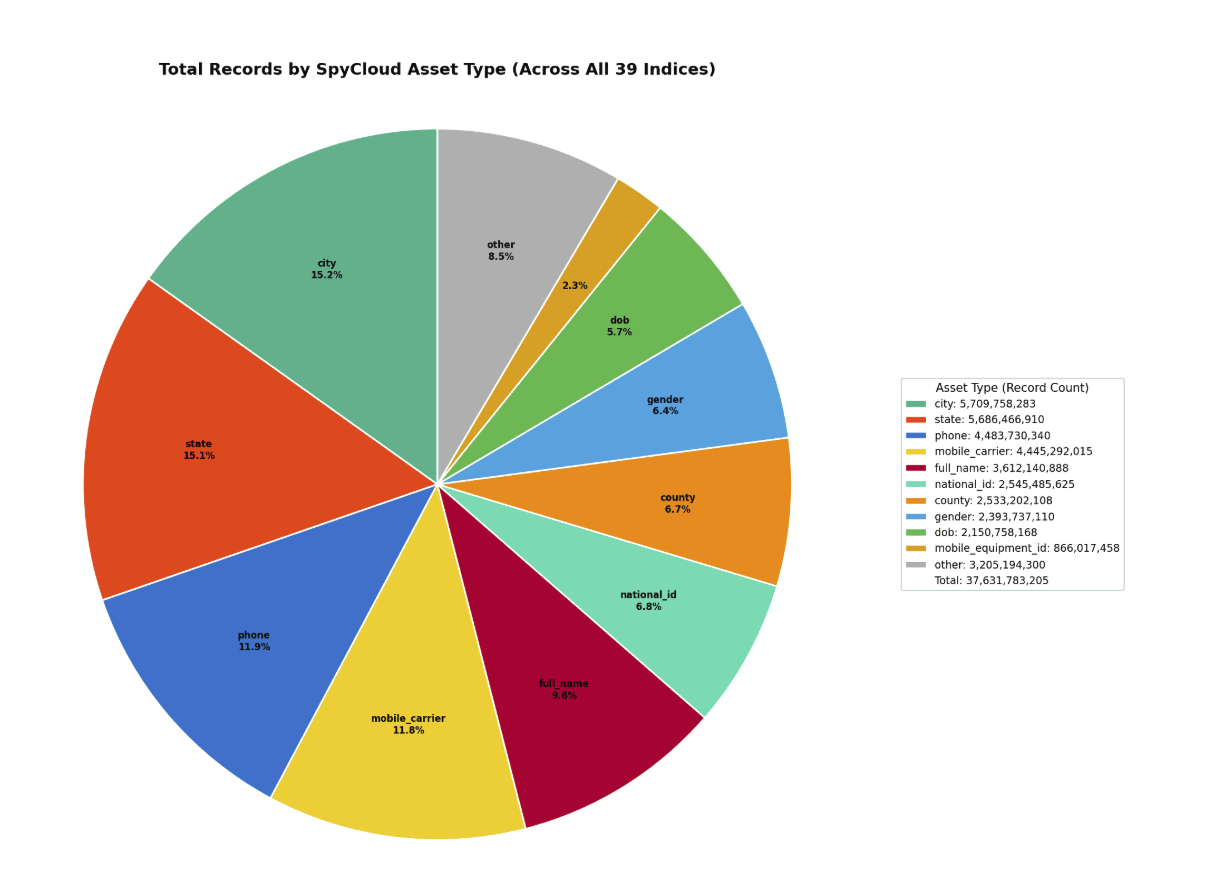 Pie chart by SpyCloud, featuring the leaked datasets.
Understanding China’s Personal Information Protection Law (PIPL)
China's PIPL(个人信息保护法), which came into effect on 1 November 2021, is the country's first comprehensive national-level legislation dedicated to protecting personal information.
Together with the Cybersecurity Law (CSL), Data Security Law (DSL) and supporting regulations, it forms a central part of China's data protection framework.
The PIPL governs how organisations collect, use, store, disclose and otherwise process personal information. It requires organisations to establish an appropriate lawful basis for processing, safeguard the information they handle and respect individuals' rights.
While consent is an important lawful basis, it is not the only one. The PIPL also permits processing in specified circumstances, such as when necessary to perform a contract with an individual or fulfil legal obligations.
Where consent is required, it must be voluntary, informed and explicitly given. Certain activities, including processing sensitive personal information and transferring personal information overseas, may also require separate consent.
Serious violations of the PIPL will result in fines of up to RMB 50 million or 5% of the company’s annual revenue, whichever is greater. Furthermore, individuals may be held directly liable, and businesses may also be sued for losses.
The PIPL is not limited to Chinese companies – any organisation that handles the data of individuals located within China may be held liable. Cross-Border Data Transfers (CBDT) are among one of the key aspects of the PIPL, where companies in China can only qualify to transfer data overseas if they satisfy stringent legal mechanisms. This includes completing a Personal Information Protection Impact Assessment every three years. More recently, some exceptions, such as companies with a data volume of under 100,000 individuals annually, have been made. However, China maintains a strict CBDT certification process, especially for higher-risk companies that handle more data.
The PIPL has been continuously updated since its inception, with numerous new key requirements enacted across 2025 and 2026 as follows:
1. The new breach reporting time crunch: When a significant network security incident occurs that compromises individuals’ personal data or causes disruption, network operators must report it to the Cyberspace Administration of China within 4 hours. Network operators from central or state authorities face a two-hour deadline, while those managing critical information infrastructure face a one-hour deadline.
2. This falls under the National Cybersecurity Incident Reporting Management Measures (国家网络安全事件报告管理办法).
3. Mandatory biennial personal information protection compliance audit: Regular audits (listed under Audit Measures, 个人信息保护合规审计管理办法) must be conducted, especially for data processors who handle more than 10 million individuals’ personal data. Organisations which manage more than 1 million individuals’ personal data must also appoint a Personal Information Protection Officer (PIPO, 个人信息保护负责人). The Audit Measures come hand-in-hand with the Audit Guidelines (个人信息保护合规审计指引).
4. More stringent rules on sensitive data: Under theData Security Technology – Security Requirements for Processing of Sensitive Personal Information (GB/T 45574-2025), companies are provided with more detailed guidance on identifying and safeguarding sensitive personal information.
Although this is a recommended national standard rather than a mandatory standard, it provides an important technical reference for organisations seeking to implement appropriate safeguards.
5. More defined framework for Cross-Border Data Transfers: China has continued to refine its cross-border data transfer requirements. The Personal Information Export Certification Measures (个人信息出境认证办法), effective from 1 January 2026, establish clearer procedures for organisations using certification as a mechanism to transfer personal information overseas. Together with existing security assessments, standard contracts and applicable exemptions, these measures provide businesses with a more structured framework for managing international data transfers while ensuring compliance with the PIPL.
6. Simplified compliance requirements for small businesses: China has also introduced more proportionate compliance requirements for smaller organisations. The Provisions on Simplified Measures for Personal Information Protection by Small Personal Information Processors (小型个人信息处理者个人信息保护简化措施规定), effective from 1 September 2026, simplify certain obligations for qualifying organisations processing personal information relating to fewer than 100,000 individuals. These include simplified approaches to privacy notices, impact assessments and compliance audits, helping smaller businesses meet their legal obligations while reducing unnecessary administrative burdens.
Following this revamp, in April 2026, China also introduced a series of nationwide special enforcement actions (个人信息保护专项行动), jointly organised by the Cyberspace Administration of China (CAC), the Ministry of Industry and Information Technology (MIIT), and the Ministry of Public Security (MPS). China has begun cracking down on applications, software, and organisations that collect excessive amounts of data. According to official figures released on 19 August 2026, authorities had inspected over 20,000 apps and SDKs, directed more than 4,000 to rectify compliance issues, and identified over 12,000 potential risks. These include organisations that collect personal information beyond the necessary scope, gather data without consent, or do not disclose the data’s collection and use. For higher-risk sectors such as health and finance, there is an increased onus on institutions to safeguard personal data from potential leaks or face legal penalties.
Emerging Challenges: AI and Personal Information Protection
Alongside these regulatory developments, the rapid adoption of artificial intelligence is introducing new challenges for organisations handling personal information.
Businesses are increasingly exploring AI applications for customer service, recruitment, marketing, financial services and internal operations. However, these technologies may involve extensive collection, analysis and sharing of personal information. For example, an organisation deploying a generative AI customer service assistant may allow the system to access customer records, transaction histories or previous communications. This raises important questions about how personal information is collected, which systems and service providers can access it, and whether the information may be transferred overseas.
Similarly, AI-powered recruitment tools may use personal information to evaluate job applicants, while personalised advertising systems may analyse individuals' preferences and behaviour to deliver targeted content. Under the PIPL, organisations must consider applicable requirements concerning lawful processing, transparency, sensitive personal information and automated decision-making. China has also established separate regulatory requirements governing certain AI applications, including algorithmic recommendation services and generative AI services.
For businesses adopting AI, privacy compliance and AI governance should therefore be considered together. Organisations need to understand what personal information their AI systems process, whether that processing is necessary and lawful, and what safeguards are required throughout the AI lifecycle. Effective governance requires collaboration between business teams, technology specialists, cybersecurity professionals and data protection officers.
Upskilling for Personal Information Protection Officers (PIPO)
This is but the tip of the iceberg. China's evolving personal information protection framework requires organisations to understand not only the legal requirements but also how these obligations apply to everyday business operations.
From managing cross-border data transfers and conducting compliance audits to responding to cybersecurity incidents and overseeing AI-related processing activities, data protection professionals play an increasingly important role in helping organisations identify risks and implement effective safeguards.
To build these capabilities, organisations looking to establish a presence in China's market, as well as those already operating there, can benefit from dedicated professional training courses or specialist consultancies that provide deeper insights into China's privacy landscape and practical guidance on navigating its regulatory requirements.
This is but the tip of the iceberg. China's evolving personal information protection framework requires organisations to understand not only the legal requirements but also how these obligations apply to everyday business operations. From managing cross-border data transfers and conducting compliance audits to responding to cybersecurity incidents and overseeing AI-related processing activities, data protection professionals play an increasingly important role in helping organisations identify risks and implement effective safeguards.
To build these capabilities, organisations looking to establish a presence in China's market, as well as those already operating there, can benefit from dedicated professional training courses or specialist consultancies that provide deeper insights into China's privacy landscape and practical guidance on navigating its regulatory requirements.