

By Dr Kevin Shepherdson, CEO, Straits Interactive
The idea of the “AI employee” is becoming increasingly attractive. Give an AI agent access to the right tools, teach it a set of skills, connect it to company systems, and it can research, analyse, draft, update records, send messages and complete work without a person guiding every step.
Watch a good demonstration and the conclusion seems obvious: we are moving from AI assistants to AI employees.
There is something important happening here. Generative AI is moving beyond producing answers towards performing work. Agents can pursue objectives, use tools, retain context across multiple steps and act within digital environments. Anthropic’s concept of Agent Skills takes this further by packaging instructions, scripts and resources that allow a general-purpose agent to follow specialised procedures. Connectivity standards such as MCP can then give the agent access to external tools, data and enterprise systems.
Put these components together and the agent starts looking less like a chatbot and more like a worker sitting in front of a computer.
That is precisely where leaders need to be careful.
An AI agent can increasingly be given the capabilities of a worker without acquiring the responsibilities of an employee. Once we separate those two ideas, the “AI employee” metaphor becomes much easier to evaluate.
From Answering Questions to Performing Work
The technological shift is real.
A conventional AI assistant waits for an instruction and produces an output. A more capable agent can instead be given an objective, break that objective into steps, retrieve information, use tools, inspect results and continue working.
Add reusable procedural knowledge and the progression becomes more interesting.
A general-purpose model may understand what a supplier assessment is. A Skill could tell it how your organisation performs supplier assessments: which documents to retrieve, what criteria to examine, how risks should be scored and what format the recommendation should take.
Connect the agent to procurement systems, document repositories and email, and it may be able to retrieve supplier records, examine contracts, prepare an assessment and update the relevant system.
The architecture is becoming increasingly powerful:
Model capability + procedural knowledge + connectivity + execution environment
That deserves serious attention from CAIOs. It is one reason Agentic AI represents more than another productivity feature.
But it still does not create an employee.
Procedures Are Not Professional Judgement
Agent Skills address an important limitation of general-purpose models. Intelligence alone does not mean an AI understands how a particular organisation expects work to be done.
A finance team could encode how monthly management reports should be prepared. HR could encode its recruitment methodology. A compliance team could specify how an investigation should proceed. A training organisation could capture how a course should be designed and quality-checked.
This creates the possibility of turning organisational methods into reusable machine-executable knowledge.
But knowing the procedure is different from being an experienced professional.
A procedure may say that contracts above a particular value require additional approval. An experienced manager may recognise that a smaller transaction still deserves escalation because the customer is unusual, the terms conflict with another commitment, or something about the circumstances simply does not look right.
People accumulate tacit knowledge. They learn from colleagues, past incidents and situations that were never completely documented. They recognise weak signals and sometimes know when mechanically following the prescribed procedure would produce the wrong result.
That gives us an important distinction:
Procedural expertise is not the same as professional judgement, and neither is the same as organisational accountability.
Agent Skills can make AI much better at executing the normal procedure. They do not automatically determine what should happen when reality stops behaving normally.
Connectivity Is Not Authority
The same distinction applies to connectivity.
An agent may technically be able to access CRM, ERP, email, databases, HR systems or financial applications. That expands what it can do.
It does not determine what it should be permitted to do.
Suppose a sales agent can retrieve a customer's purchase history, prepare a quotation, update the CRM and send an email. Does that mean it should also offer a 20 per cent discount? Extend credit? Change contractual conditions? Promise an exceptional delivery date?
A human employee may have access to all the same systems while still being constrained by approval limits, segregation of duties, professional obligations and financial controls.
Agentic systems need the same distinction. The CAIO therefore has to ask two different questions:
What can the agent technically do?
and
What has the organisation deliberately authorised the agent to do?
The second is ultimately the more important one.
What Makes an Employee More Than an Executor?
This is where the term “AI employee” begins to become problematic.
If we compare humans and AI only by the number of tasks they can perform, the analogy will become increasingly persuasive. AI capability is advancing quickly.
But employment involves far more than executing tasks.
The point is not that humans possess capabilities AI will never acquire. Some of these gaps will narrow substantially.
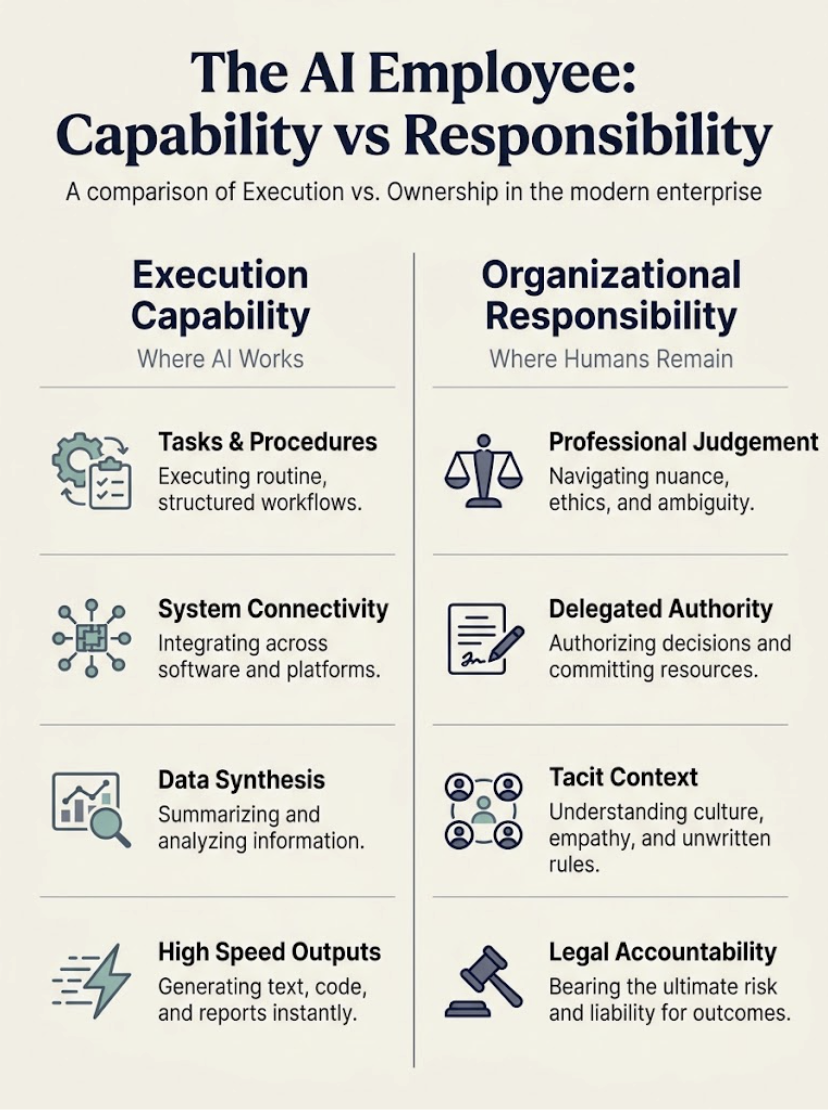
The more useful observation is where the analogy works—and where it stops working. The “AI employee” looks increasingly plausible when we examine:
Capability → Procedure → Connectivity → Execution
It becomes much weaker when we move into:
Judgement → Authority → Professional obligation → Accountability → Consequences
Yet impressive demonstrations often show the first group and encourage viewers to assume the second group follows automatically.
It does not.
That is the point where the “AI employee” metaphor needs to be handled with care. The technology is clearly advancing from assistance towards execution, and that shift is significant. But execution capability should not be mistaken for organisational responsibility.
Before treating an agent as an employee, leaders need to separate what the system can do from what it is permitted to decide, how reliably it performs outside the normal path, and who remains accountable for the consequences.
Part 2 takes that question into the workflow itself—because the next misunderstanding is even more consequential: an agent may execute a workflow without owning the workflow.